Where Did Many Baby Boomer Live During 1950s?
 The two decades post-obit World War II were characterized by a massive upswing in nativity rates in the Usa and other countries – the and so-called 'baby Smash'. While the traditional explanation of the Baby Boom is that families made upwardly for babies that were delayed due to the war, in new research Matthias Doepke suggests an alternative caption. He argues that the Babe Boom of the 1950s was fuelled by the crowding out of younger women from the labor force by older women who had gained work feel during the war. These younger women and then got married and had babies earlier, and in greater numbers.
Between the cease of World State of war II and the early 1960s, the United States experienced a remarkable baby smash. The total fertility charge per unit (a measure of the number of children each woman will accept, given electric current fertility patterns) increased from simply over ii before the war to a peak of close to 4 children per woman in the late 1950s (Effigy 1). The large variations in cohort sizes generated by the baby boom have shaped the US economic system ever since, including the economic nail in the 1990s when the baby boomers were in their meridian earning years, and the daunting challenges in financing retirement and health benefits in the coming decades as the infant boomers enter retirement.
Figure 1 – Total fertility charge per unit in the United States
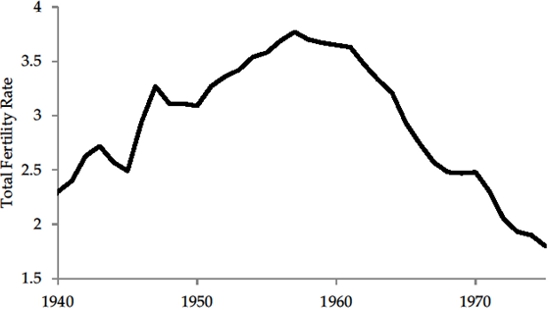
While at that place is substantial understanding on the consequences of the baby boom for the U.s. economy, the underlying causes of the rise in fertility have remained controversial. A defining point in this argue is the role of World State of war 2 in explaining post-war fertility. Initially, the fact that fertility rates started to ascension soon afterward soldiers returned habitation from the battlefields suggested to many that the baby boom may be due to families making up for the babies they did not have while husbands were serving in the armed services. Nonetheless, a detailed look at the data reveals that this mechanism can explain at most a pocket-sized fraction of the infant nail. Fertility peaked in the late 1950s, and well-nigh of the rise in fertility is due to young mothers under the age of 25. Hence, the mothers who gave birth at the peak of the baby boom were more often than not too immature to be married to men who served in the war. Given this mismatch, for many years research into the causes of the baby boom has focused on mechanisms unrelated to the war, such as innovations in household technology or the consequences of the Keen Depression.
In recent research with Moshe Hazan and Yishay Maoz, we argue that the World War II was responsible for the infant nail later on all, albeit through a more than subtle mechanism than the want for kids of returning soldiers. In our view, much of the baby smash tin be explained past the ramifications of Globe State of war II for women'southward labor marketplace opportunities. Indeed, the war was a watershed moment for American women's role in the labor force. As the men were fighting in Europe and Asia, millions of women joined the labor force, and they were responsible for a large office of the rise in wartime product. Women had been working before the war, too, merely nigh exclusively in their early twenties earlier getting married. The big modify during the war was that older married women, including those with children, as well entered employment.
The surge of female employment during the war proved to be a watershed, because many women who joined the war production attempt liked the experience, and decided to stay in the labor force even after the men returned home. Hence, in the ii decades after the terminate of the war nosotros observe a large increase in the labor supply of married women.
Now as far as explaining the baby smash is concerned, pointing out that the war increased female employment may appear to make the puzzle even bigger – after all, having children and having a job are two activities that compete for time, so that a ascension in female employment generally tends to continue with fewer babies. However, the primal to our argument is that the surge in female person employment had opposite furnishings on two different cohorts of women: the war generation of women one-time enough to piece of work in World State of war 2, and younger women still in school during the war who would achieve childbearing in the late 1940s and 1950s.
The women of the war generation benefitted from the additional piece of work experience, and thus connected to work at loftier rates throughout their machismo. In contrast, women in the younger cohort had a much harder time finding employment, because they had to face potent competition from the experienced war generation. Before the war, female employment was the most exclusive domain of young, single women. As these women married they used to gratuitous up jobs for the next generation. In the post-state of war years, in contrast, many jobs were already taken by the older women, resulting in dire employment prospects for the post-obit cohorts.
With the older women dominating the labor market, immature women were crowded out, and had to look for something else to practise. Many of the younger women adapted by getting married and starting to have babies a little earlier than they would have had they been employed. Ultimately, they ended up edifice bigger families with more children. It is the story of these younger women that explains virtually of the baby nail.
Figure 2 – Total labor supply past younger (twenty-32) and older (33-lx) women in the U.s.a. (equally a per centum of labor supply past men in the same age group)
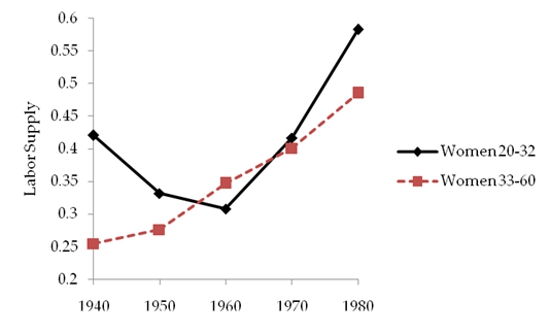
Our account of the babe nail is consequent with the ascertainment that the employment of younger (i.due east., childbearing age) and older women moved in opposite directions subsequently the state of war (Figure two). Evidence on variation in the baby boom beyond Us states is also consequent with the mechanism. States with college mobilization rates (i.east., a higher fraction of men joining the military machine) had a larger surge in female employment during the war and a larger rise in fertility afterwards the war. A final piece of evidence comes from variation across countries. Many countries were afflicted by the state of war, but only a few countries experienced a large rise in wartime female employment. We should await the post-war babe boom to exist big only those countries where female employment surged. The testify lines upwards precisely with this prediction. Canada, New Zealand, and Commonwealth of australia are the three countries with a war time experience very similar to the The states, in terms of a large rise in female employment and also in terms of the absence of major war time destruction (which may take a separate consequence on mail service-war fertility). Figure three shows that the baby boom was large and similarly timed in all of these countries. In dissimilarity, in the neutral European countries (which also escaped state of war time destruction, but didn't experience a rise in female employment), there is no pronounced rise in fertility after the war (Effigy four).
Figure iii – Completed fertility rates (i.e., average number of children per adult female in a given nascence accomplice) in the United States and allies with a similar state of war experience.
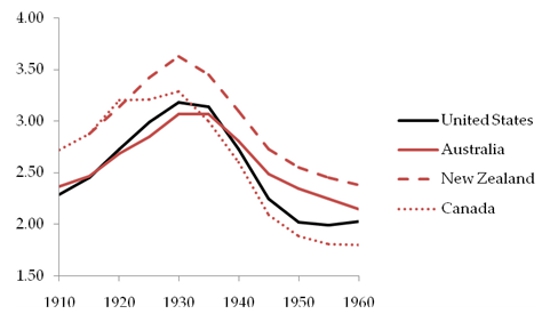
Note: The baby nail corresponds to birth cohorts (i.east., nativity year of the mother) 1920-1940.
Figure four – Completed fertility rates (i.e., average number of children per woman in a given birth cohort) in the The states and neutral countries.

Note: The baby blast corresponds to birth cohorts (i.e., birth twelvemonth of the female parent) 1920-1940.
Today's demographic challenges are quite different from those of the baby boom period; notably, many industrialized countries now suffer from extremely low fertility rates, population aging, and population decline. Nevertheless, our work suggests that the key tradeoff that drives fertility today, namely betwixt work and careers on the one hand and childbearing on the other hand, was every bit responsible for explaining fertility trends during the postwar infant boom.
This article is based on the newspaper "The Baby Boom and World State of war II: A Macroeconomic Assay" in the Review of Economic Studies.
Featured image credit: USMC Athenaeum (Flickr, CC-By-2.0)
Please read our comments policy before commenting.
Note: This article gives the views of the author, and not the position of USAPP – American Politics and Policy, nor the London Schoolhouse of Economics.
Shortened URL for this mail: http://fleck.ly/1WziuSg
_________________________________
About the author
Matthias Doepke – Northwestern University
Matthias Doepke is a Professor of Economics at Northwestern Academy, an NBER Enquiry Associate, and a CEPR Enquiry Fellow. He received a Ph.D. in Economics from the University of Chicago in 2000. His research areas include economic growth and evolution, political economy, macroeconomics, and monetary economics.
perezwhistless1984.blogspot.com
Source: https://blogs.lse.ac.uk/usappblog/2015/11/04/how-rosie-the-riveter-led-to-the-1950s-baby-boom/
0 Response to "Where Did Many Baby Boomer Live During 1950s?"
Post a Comment